SpacesExplainer6 min read
What Is Gaussian Splatting? A Plain-English Guide for 2026
Gaussian Splatting is the technology turning phone videos into photorealistic 3D scenes. Here's how it works and why it matters.
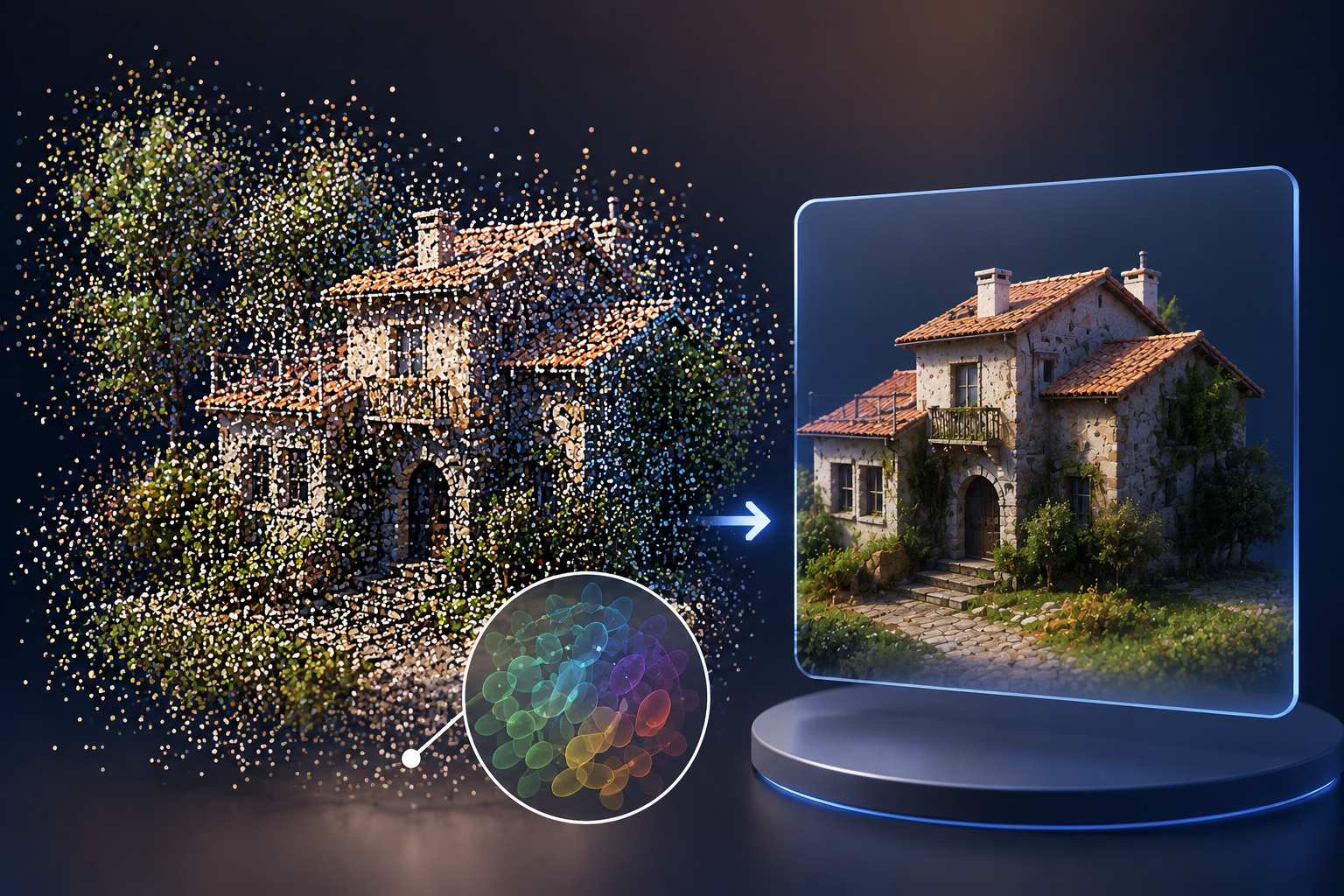
In 2023, a research paper from Inria introduced a new way to represent 3D scenes that was faster, sharper, and more interactive than anything that came before. Three years later, Gaussian Splatting is going mainstream, used in real estate, retail, architecture, and cultural heritage preservation. Here's what it is and how it works.
The short version
You film a room, a product, or a location with your phone. An algorithm analyzes the video, figures out where the camera was at each frame (Structure from Motion), and then places millions of tiny 3D blobs called Gaussian primitives that together reconstruct the scene. The result is something you can walk through in a browser at 60fps.
How is it different from photogrammetry or NeRF?
- Photogrammetry (e.g. RealityCapture) produces a polygon mesh with baked textures. Great for clean geometry, but can struggle with glass, hair, or complex lighting.
- NeRF (Neural Radiance Fields) produces stunning results but is slow to render. It needs to query a neural network for every pixel, every frame.
- Gaussian Splatting stores the scene as an explicit set of 3D blobs, each with a position, size, opacity, and color. Rendering is fast because it's a direct rasterization, not a neural computation.
What do you need to create a Gaussian Splat?
- A video or set of photos (a smartphone video is fine for most scenes)
- Processing software: PostShot, Nerfstudio, OpenSplat, or the original 3DGS repository
- A GPU for training (typically 15-60 minutes on a consumer NVIDIA card)
- A viewer to display the result, like Luxa's Walk-in Gaussian Editor
Real-world use cases
- Real estate: virtual walkthroughs that look better than traditional 360° photos, no fisheye distortion
- Retail: capture a store or showroom and let customers browse online
- Architecture: show a completed project before construction is finished by scanning a scale model
- E-commerce: place a Luxa 3D product viewer inside a Gaussian scene of your actual store
- Cultural heritage: preserve historical sites at photorealistic quality
The catch
Gaussian Splats are large files (50-500 MB for a room) and require WebGL or WebGPU to render. They're also purely visual: you can't yet extract a clean mesh for manufacturing or game engines without additional steps. For visualization and walkthroughs, the quality-to-effort ratio is unmatched.
Put your showroom online.
We build it in 3D, with your products in it, and hand it over ready to share.
More from the blog